
A refrigerated truck body is one of the few purchases where the figure on the proforma invoice is the smallest number that matters. Between the factory gate and a working vehicle you will pay for ocean freight, import duty, local assembly and compliance — and each of those lines changes dramatically depending on whether the body ships as a finished box (CBU), as pre-built major assemblies (SKD) or as a flat-packed kit (CKD). This guide breaks the landed cost of an insulated body into its components, compares the three delivery modes side by side, and walks through a worked example — including the honest caveats about import duty that most supplier pages leave out.
What CKD, SKD and CBU Actually Mean for a Truck Body
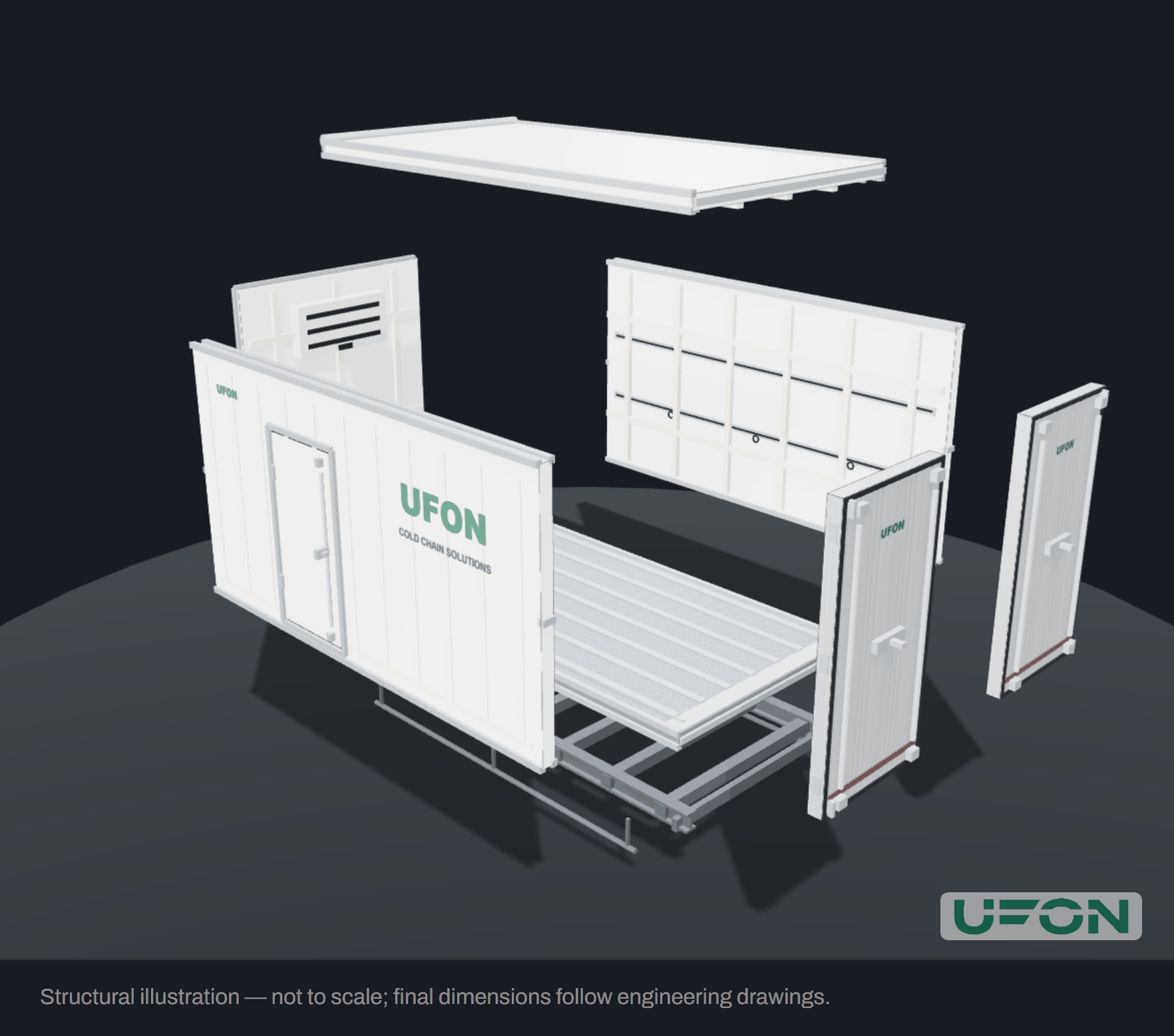
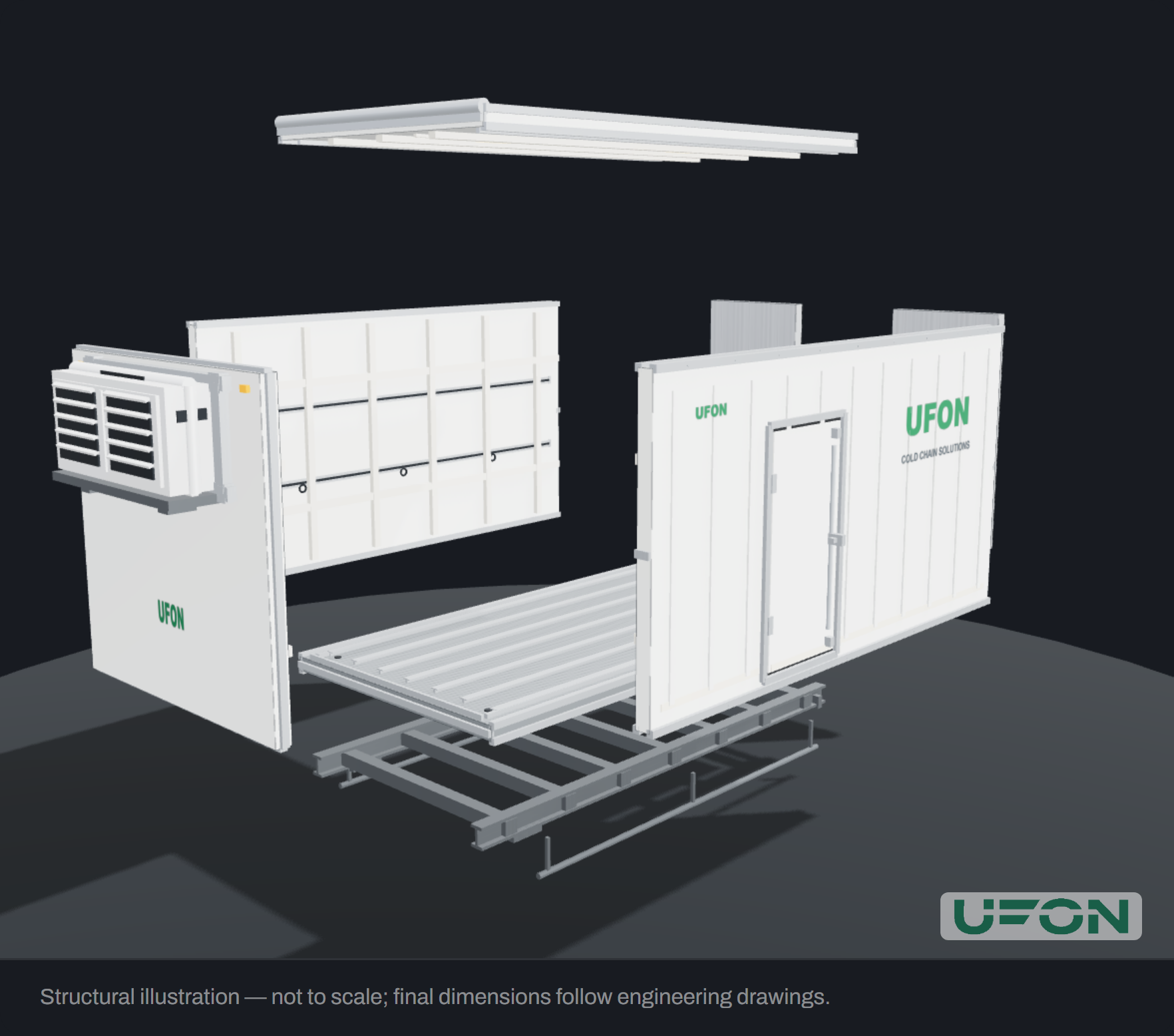
The three terms describe how much factory work is completed before the body leaves the plant. They come from the automotive industry, and they map cleanly onto insulated truck bodies because a modern sandwich-panel body is itself a set of modules: roof, front wall, two side walls, a floor system, two rear doors and a sub-frame. The more of that assembly work the factory does, the less you do at destination — and the more air you ship.
CBU — finished body, mount and go
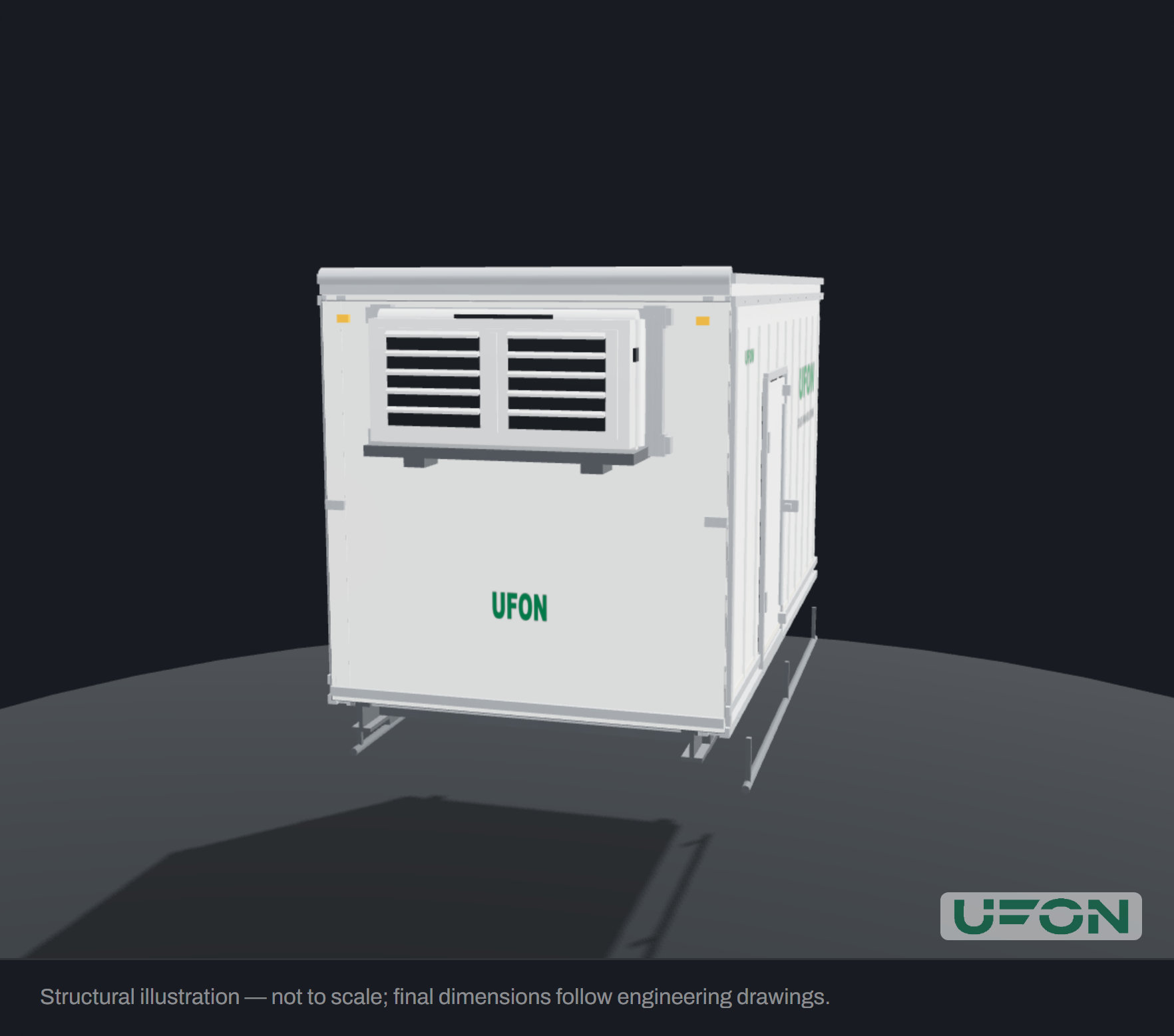
A CBU (Completely Built Up) body arrives fully assembled, sealed and inspected. Locally you lift it onto the chassis, bolt down the sub-frame, connect the refrigeration unit and wire the lights. Local labor is minimal, quality responsibility sits unambiguously with the factory, and the vehicle can be working within days of arrival. The trade-off: you are shipping a large rigid box that is mostly air, and it crosses the border as a finished good.
SKD — major assemblies pre-built
SKD (Semi Knocked Down) ships the body as a small number of large, pre-built assemblies — typically the panel set, doors and sub-frame — that join together quickly with basic tools. Assembly time drops from days to hours, while freight volume falls well below a finished box. SKD suits buyers who have a workshop and want meaningful freight savings without running a full panel-assembly operation.
CKD — flat-packed panels and parts with drawing sets
CKD (Completely Knocked Down) is the extreme: every panel, profile, door, fastener and sub-frame member is flat-packed and palletized, shipped with a full drawing set and assembled at destination. A flat-packed kit uses container space far more efficiently than a finished box, and in many markets kit form also changes the customs tariff classification. The trade-off is real work at destination: a workshop, trained labor and disciplined quality control.
The Three Bills You're Actually Paying
Whichever mode you choose, the landed cost of an imported body is the sum of four lines: the FOB price, ocean freight, import duty and local assembly. The FOB difference between modes is usually modest — the same panels and hardware go into the box either way. The other three lines are where the modes diverge.
Freight: why a flat-packed body ships more units per container
A finished insulated body is a rigid box roughly the width and height of a container door, so in practice each CBU body consumes most of a container by itself. Flat-packing changes the geometry completely: panels stack like sheets of plywood. Industry suppliers publishing loading figures report on the order of five CKD bodies in a 20 ft container and ten to fifteen in a 40 ft container (indicative third-party figures; the exact count depends on body size). For bulky, low-density cargo like an insulated box, freight per unit can be a major saving lever, but the actual result requires an order-specific packing plan and freight quote.
Import duty: parts vs finished goods tariff lines
Customs duty is charged on the customs value at a rate set by the tariff line your goods are classified under — and in some markets finished vehicles and bodies sit on different lines from parts and kits. Published industry comparisons quote indicative duty ranges of roughly 15–35% for CBU units, around 5–15% for SKD and roughly 0–5% for CKD kits, though the spread between countries is enormous and these ranges are not a tariff determination. Classification is decided by your destination's tariff schedule and the actual completeness of the kit. Trade-remedy tariffs can apply regardless of kit form: industry guides note that US Section 301 duties follow the HS code and do not disappear because goods ship knocked down. Duty treatment is a country-specific question, not a product feature.
Local assembly: labor hours, tools and workshop requirements
Assembly is where CKD spends back some of its savings. Published figures span a wide range — from about 1.5 labor-hours for a highly pre-assembled kit to 20–40 hours for a fully knocked-down body — because 'CKD' covers everything from bonded, pre-fitted panels to loose sheets and profiles. Realistic planning numbers sit between those extremes: suppliers of modular kits report that semi-skilled crews with basic tools can complete a body in one to a few days once trained. Budget for a drill, rivet gun, torque wrench, lifting gear and sealants, plus flat floor space to lay out panels. Our separate assembly guide covers tools, sequence and quality checks in detail.
Cost Comparison: CBU vs SKD vs CKD at a Glance
| Dimension | CBU (built up) | SKD (semi knocked down) | CKD (flat pack) |
|---|---|---|---|
| Arrival condition | Finished body, mount and go | Pre-built major assemblies | Flat-packed panels, parts and drawing set |
| Container utilization | Baseline — about one body per 40 ft container (typical practice) | Improved over CBU | High — indicative 10–15 bodies per 40 ft container |
| Import duty (indicative) | High — published ranges roughly 15–35% | Mid — roughly 5–15% | Low — roughly 0–5%, but country-specific |
| Local assembly input | Minimal — mount and connect | Hours with basic tools | Days; workshop, tools and trained crew |
| Quality risk | Lowest — factory-integrated inspection | Low to medium | Medium — depends on local discipline |
| Lead time to working vehicle | Fastest | Medium | Longest (adds assembly time) |
| Best fit | Trial orders, urgent units, no local workshop | Buyers with basic assembly capability | Volume orders into duty-sensitive markets |
Worked Example: A 10-Body Order into a High-Duty Market
Numbers make the comparison concrete. The figures below are illustrative — not a quotation — but they show the mechanics. Take a purely hypothetical customs value of $10,000 per body, and assume your customs broker confirms a 25% CBU duty line versus 5% for CKD kits in your market (both inside published indicative ranges).
Container math for CKD vs CBU
Freight first. Ten finished bodies would typically need on the order of ten container moves, because each rigid box fills most of a 40 ft container by itself. The same ten bodies as flat-packed kits fit in roughly one 40 ft container at the indicative loading figures cited above. Even after adding pallets, packaging and handling, cutting ten container moves to one is usually a four-figure saving per body on long routes — before duty even enters the picture.
Duty base difference and why it compounds
Duty second. On the illustrative $10,000 customs value, a 25% CBU line costs $2,500 per body; a 5% CKD line costs $500. That is a $2,000 difference per body, or $20,000 across the ten-body order. This is scenario arithmetic, not a promised saving. Assembly then spends some of it back: at published labor ranges, a trained crew might add the equivalent of a few hundred dollars per body in local wages. The net result depends on confirmed duty lines, real freight quotes and local assembly cost. If your broker tells you kits and finished bodies share the same tariff line in your market, the arithmetic changes completely and freight becomes the main logistics lever.
When CBU Is Still the Right Choice
CKD arithmetic only works at volume. One industry guide puts the rough threshold at around 200 units per year before a dedicated CKD assembly operation pays back — below that, the workshop, training and quality overhead eat the savings. For trial orders, single replacement bodies, urgent deliveries, or markets without duty differentiation, CBU is usually cheaper overall once your own time is priced in. SKD sits deliberately in the middle: real freight savings, hours of assembly instead of days, and no need for a full kit workshop.
Trial orders, single units, no local workshop
Choose CBU when you are validating a new supplier, testing a route or filling an urgent gap in the fleet. The landed cost per body is higher, but your organizational cost is near zero — the body arrives inspected as a unit, and responsibility for its condition is unambiguous.
The Honest Caveats: Duty Savings Are Country-Specific
Most supplier pages present CKD duty savings as automatic. They are not. Whether a kit is taxed as parts or as a finished vehicle is decided by your destination's tariff schedule, and sometimes by how complete the kit is — customs authorities can and do reclassify near-complete kits as finished goods. Treat every percentage in this article as indicative until your own broker confirms it.
Confirm HS classification with your customs broker
Before you choose a delivery mode, ask your customs broker two questions: which HS line applies to an insulated truck body kit, and which applies to the finished body. Get the answer in writing, with the duty rate and any trade-remedy surcharges attached. If both modes land on the same line — as some jurisdictions have ruled — plan on freight and logistics savings only.
What to ask your supplier before choosing CKD
On the supplier side, ask for five things: the exact packing list and kit completeness (every missing bracket becomes a local fabrication job); the drawing set and part-labeling system; the degree of pre-assembly, because it moves assembly time by an order of magnitude; packaging and moisture protection for panels in transit; and what happens if a panel arrives damaged — a modular design should let you reorder a single module rather than a whole body.
How UFON Ships: CBU, SKD and CKD Options
UFON builds every refrigerated body as eight engineered modules — roof, front wall, side walls, floor system, rear doors and sub-frame — so the same body can ship three ways: CBU, finished and inspected at the factory; SKD, with major assemblies pre-built; or CKD, flat-packed with a full drawing set for local assembly. Panels up to 100 mm thick, PU / XPS / PET / PP-honeycomb cores and FRP, aluminum, 304 stainless or galvanized skins carry over identically between modes — you are choosing a logistics format, not a different product. Tell us your destination, chassis and annual volume, and our engineers will come back with a delivery plan oriented to landed cost.
FAQ
How much cheaper is a CKD refrigerated truck body than a CBU one?
There is no honest single percentage. Compare an order-specific packing plan and freight quote, destination-specific duty treatment, and local assembly labor. Published indicative duty ranges are not a tariff determination; in markets where kits share the CBU tariff line, freight and logistics become the main comparison levers. Confirm your classification and rates before trusting any percentage.
Do CKD body kits really pay lower import duty?
Sometimes yes, sometimes no — it is decided by your destination's tariff schedule, not by the supplier. Some countries tax parts and kits on different lines from finished vehicles; others reclassify near-complete kits as finished goods. Trade-remedy tariffs such as US Section 301 follow the HS code regardless of kit form. Get a written classification and rate from your customs broker before you commit.
How many CKD refrigerated bodies fit in a 40 ft container?
One truck-body builder publishes roughly five CKD bodies in a 20 ft container and ten to fifteen in a 40 ft container — their figures, and the real count depends on body dimensions and packaging. For contrast, a finished CBU body typically consumes most of a container by itself. That asymmetry is the core of the freight saving.
How long does it take to assemble a CKD refrigerated body?
Published figures range from about 1.5 labor-hours for a highly pre-assembled kit to 20–40 hours for a fully knocked-down body — the degree of pre-assembly is the deciding variable. A realistic middle ground for a modular kit is one to a few days for a semi-skilled crew following the drawing set. Ask every supplier to state the pre-assembly level explicitly before comparing quotes.
What order volume makes CKD worth it?
One industry guide suggests roughly 200 units per year as the break-even point for a dedicated CKD assembly operation; below that, SKD or CBU usually wins on total cost. Your true threshold depends on the duty differential, freight rates and local labor cost in your market — run your own numbers with broker-confirmed rates rather than generic rules of thumb.
Sources & scope
These sources were reopened and checked on 2026-11-12. Third-party figures are industry references, not UFON test results; project decisions require confirmed drawings, datasheets and destination-specific requirements.
- Chinese Truck Factory — CKD vs SKD vs complete truck exportIndicative duty and assembly-time ranges and the 200-unit annual-volume rule of thumb; complete-truck context, not UFON data. Accessed 2026-11-12.
- Bullex — Refrigerated truck body kit specifications and packingSupplier-published CKD loading ranges and assembly-support claims; actual loading depends on the body and packaging. Accessed 2026-11-12.
- HONGLI — SKD vs CKD kits and duty caveatsCountry-specific tariff classification and Section 301 caveats; forklift context used only for the customs warning. Accessed 2026-11-12.