
Ask three body builders which insulation core is best and you will get three confident answers — each correct for a different duty cycle. The honest answer is that PU, XPS, PET and PP honeycomb are not ranked on a single scale; they trade thermal performance, moisture behavior, strength, weight and end-of-life against each other. UFON manufactures panels with all four cores, so we have no reason to push one. What follows is a spec-first comparison using published industry data ranges, followed by a duty-cycle decision guide you can apply to your own fleet.
The Four Cores in One Table
The table below collects indicative ranges published by panel-industry sources. Treat them as orientation, not specification: actual values depend on density, formulation and skin system, and any supplier — including us — should back a quoted figure with a datasheet for the exact product.
| Property (indicative ranges) | PU foam | XPS foam | PET foam | PP honeycomb |
|---|---|---|---|---|
| Initial thermal conductivity λ (W/m·K) | 0.022–0.028 | 0.028–0.035 | 0.030–0.040 | 0.050–0.080 |
| Water absorption | ~1–3% by volume | Very low (≤0.3% typical) | Low (<1% typical) | Low; open cells drain and dry |
| Compressive strength | 0.10–0.30 MPa | 0.20–0.70 MPa | 1.5–5 MPa | ~0.5–3.0 MPa; excellent flatwise load spread |
| Long-term thermal stability | Declines — blowing-agent drift | Stable over time | Stable over time | Not used for insulation duty |
| Recyclability | No — thermoset | Limited | Yes — 100% thermoplastic; high rPET content possible | Recyclable |
| Typical truck-body use | Chilled and frozen bodies | Chilled and frozen bodies | Structural and sustainability-led builds | Dry freight, floors, doors |
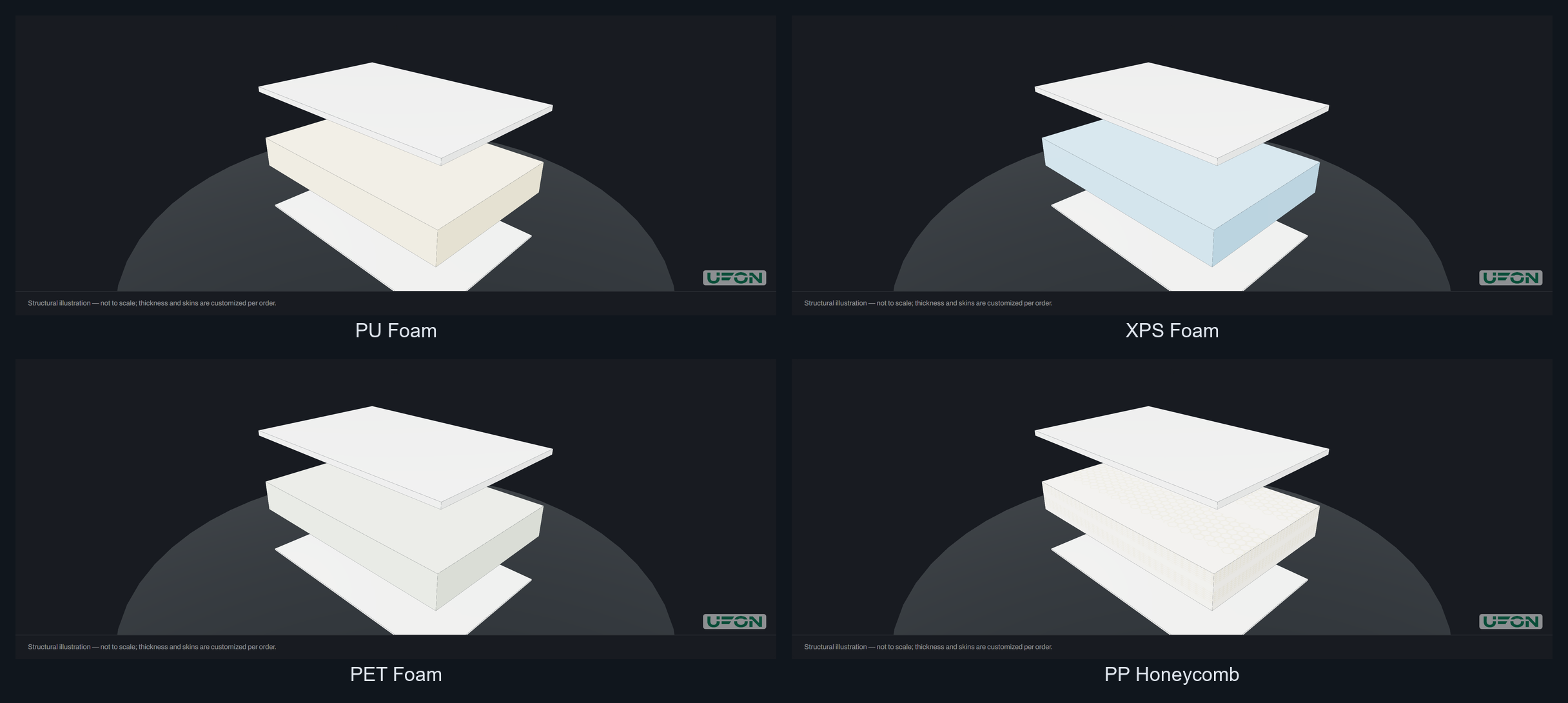
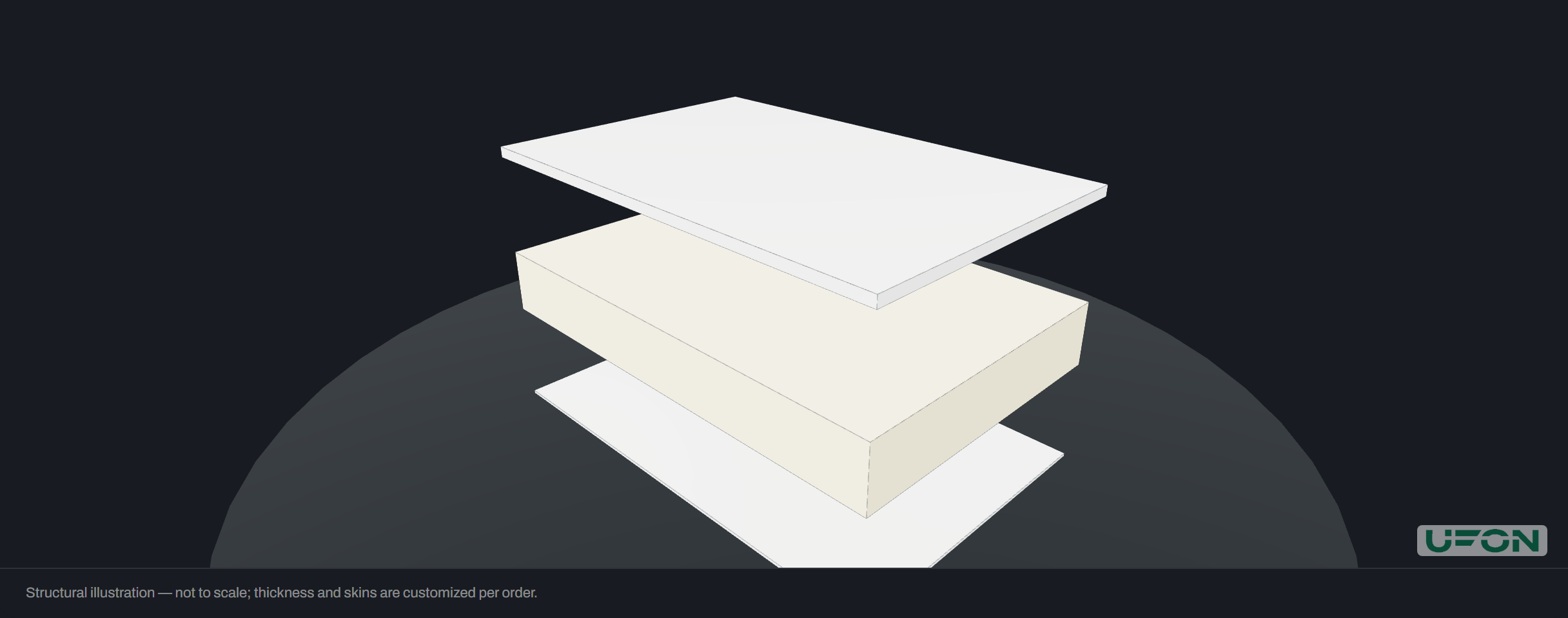
PU Foam — Best Insulation per Millimeter
Where PU wins: maximum thermal performance, thin walls
Polyurethane foam posts the lowest thermal conductivity of the mainstream cores — published initial values run roughly 0.022–0.028 W/m·K — which means the thinnest wall for a given thermal target. Every millimeter saved on wall thickness is a millimeter of internal cargo width on both sides of the box, and that is why PU has long been the default core for refrigerated bodies. One panel-industry comparison sums the field up neatly: XPS wins on cost and moisture resistance, PET wins on recyclability and shear strength, and PU wins on thermal insulation.
The ageing question: blowing-agent drift over 5–7 years
PU's headline number comes with an asterisk that few supplier pages mention: the low initial conductivity depends on the blowing gas trapped in the cells, and that gas slowly diffuses out. One technical analysis tracks PU drifting from around 0.022 toward roughly 0.030 W/m·K over five to seven years — at which point it sits in XPS territory. For a buyer, the practical rule is to ask whether a quoted λ is the initial or the aged value, and to size walls for the thermal performance you need in year seven, not just on delivery day.
XPS Foam — The Moisture-Proof Workhorse
Closed-cell structure and stable long-term λ
Extruded polystyrene is a closed-cell foam with very low water absorption — typically cited at ≤0.3% — and a conductivity that stays where it started instead of drifting over the years. Its initial λ of roughly 0.028–0.035 W/m·K is behind fresh PU, but it holds that line in wet, humid, high-pressure-wash environments where other cores gradually load up with moisture. For refrigerated duty, moisture is the silent killer of insulation performance, and XPS is the industry's standard answer to it.
When XPS belongs on the shortlist
Fleets that keep bodies in service for years in wet climates may value predictable aged performance and low water absorption over the best possible day-one conductivity number. If your fleet strategy is long service life in humid or wash-down conditions, XPS belongs on the shortlist alongside PU; compare the specific grades and aged-performance data rather than assuming one core fits every route.
PET Foam — Strength Plus Recyclability
Compressive and shear strength for structural duty
PET foam is the structural athlete of the group: published compressive-strength ranges run from about 1.5 to 5 MPa at densities of roughly 80–250 kg/m³, an order of magnitude above PU at comparable weight, with strong shear performance that suits load-bearing sandwich structures. Its thermal conductivity — roughly 0.030–0.040 W/m·K — is mid-pack: a competent insulator for chilled duty, though not the choice when maximum thermal performance per millimeter is the goal.
Circular-economy angle: recycled content and end-of-life
PET's other differentiator is what happens at the end of the vehicle's life. It is a thermoplastic core, and recycled content, recovery options and fire performance depend on the exact product grade and local waste stream. Where a tender carries sustainability or fire-performance criteria, request the grade-specific datasheet and test documentation instead of treating the polymer family alone as proof.
PP Honeycomb — When Rigidity Matters More Than Insulation
Polypropylene honeycomb is not really an insulation material — published conductivity ranges of 0.050–0.080 W/m·K put it well behind the foams — and it should not be specified as one for refrigerated duty. What it offers instead is an outstanding stiffness-to-weight ratio and flatwise load distribution that shrugs off forklift traffic and point loads. That makes it the natural core for dry freight bodies, floor systems, door leaves and furniture-grade panels, where UFON supplies it with an optional nonwoven surface veil for clean skin bonding.
Decision Guide: Match the Core to Your Duty Cycle
Chilled (0 °C) city delivery
Short routes, frequent door openings, humid loading docks: moisture management matters as much as raw conductivity. XPS is the conservative pick here, with PU the alternative when wall thickness is constrained. Either way, door discipline will affect your fuel bill more than the last decimal of λ.
Frozen (-20 °C) distribution
Frozen duty raises the thermal stakes: a bigger temperature difference across the wall, and real cost when the box warms. PU earns its premium here if thickness is limited, while XPS is the stable long-horizon choice; both typically run in the 75–100 mm thickness class at this temperature (see our panel-thickness guide). Size the refrigeration unit together with the box — panel and unit are one decision.
Deep-frozen (-25 °C) long-haul
At deep-frozen setpoints, aged thermal performance dominates the economics, and the assembled body matters more than the flat-panel datasheet — corners, doors and floor rails all leak heat. Specify the maximum thickness class, demand aged λ values, and treat door seals and thermal-bridge control as part of the insulation decision.
Dry freight / non-insulated
With no temperature target, insulation value drops out of the equation and the choice is purely structural: PET foam where you want strength plus a recyclability story, PP honeycomb where minimum weight and maximum rigidity rule. This is the one duty cycle where specifying PU would be paying for performance you never use.
Skins Matter Too: FRP, Aluminum and Stainless Pairings
The core is only half the sandwich. The skins set the surface behavior: FRP/GRP gelcoat gives a UV-stable, waterproof, easy-to-clean face; aluminum saves weight and handles knocks differently; 304 stainless suits hygiene-critical interiors and harsh wash-down regimes; galvanized steel is the economy option. Skin choice moves weight, hygiene compliance, repair cost and appearance — specify core and skin as a system, and ask how the two are bonded, because the adhesive joint is what turns three layers into one panel.
What UFON Offers
UFON manufactures foam-core sandwich panels across all four cores, positioned exactly as this guide frames them: PU as the insulation benchmark, XPS as the moisture-resistant proven choice for cold chain, PET combining strength, light weight and full recyclability, and PP honeycomb for high rigidity at minimal weight. Panels are built to order up to 100 mm thick, with FRP/GRP gelcoat, aluminum, 304 stainless or galvanized skins, and rated across our published temperature classes: 0 °C chilled, -20 °C frozen and -25 °C deep-frozen. Send us your duty cycle — cargo, route climate and door-opening pattern — and we will propose a core, skin and thickness combination with the reasoning shown.
FAQ
Is PU or XPS better for a refrigerated truck body?
It depends on your time horizon. PU posts the best initial thermal conductivity, so it wins on day one and where wall thickness is limited. But PU's λ drifts as the blowing agent ages — one analysis tracks it from ~0.022 toward ~0.030 W/m·K over five to seven years — while XPS stays stable and shrugs off moisture. Fleets keeping bodies for a decade in wet climates often land on XPS; maximum-performance builds often land on PU sized for the aged value.
Is PET foam a good insulator for truck bodies?
Adequate, not class-leading: published conductivity ranges of 0.030–0.040 W/m·K put PET behind PU and roughly level with XPS. PET's real selling points are structural strength and its thermoplastic recovery potential. Recycled content and end-of-life options are grade- and location-specific, so request the datasheet and local recovery evidence for sustainability-led tenders.
What is the thermal conductivity of each foam core?
Indicative published ranges: PU 0.022–0.028 W/m·K (initial, drifts upward with age), XPS 0.028–0.035, PET 0.030–0.040, PP honeycomb 0.050–0.080. These are industry ranges, not UFON product specifications — always specify against the datasheet of the exact product, and ask whether quoted values are initial or aged.
Can PP honeycomb panels be used for refrigerated bodies?
Not as the primary insulation. PP honeycomb's conductivity (roughly 0.050–0.080 W/m·K published range) is too high for serious thermal duty. Its strengths are rigidity, flatwise load distribution and minimal weight — which is why it is the right core for dry freight bodies, floors and door leaves, where UFON offers it with an optional nonwoven veil.
Which core should I choose for a -20 °C frozen body?
PU or XPS, typically in the 75–100 mm thickness class, chosen with the refrigeration unit as one system. Pick PU when wall thickness is constrained and you size for the aged λ; pick XPS when long-term stability and moisture resistance matter most. UFON's published temperature classes cover -20 °C frozen and -25 °C deep-frozen duty — tell us your route and climate and we will propose the combination.
Sources & scope
These sources were reopened and checked on 2026-11-12. Third-party figures are industry references, not UFON test results; project decisions require confirmed drawings, datasheets and destination-specific requirements.
- Rax Panel — Sandwich panel core materialsManufacturer-published indicative conductivity and compressive-strength ranges; not UFON product datasheets. Accessed 2026-11-12.
- HOTECH Engineering Team — Refrigerated body insulationAgeing, moisture and whole-body thermal-bridge discussion; numeric values remain third-party data, not UFON test results. Accessed 2026-11-12.